Showing posts with label BBC. Show all posts

Thursday, November 22, 2012

Thankful for Geography

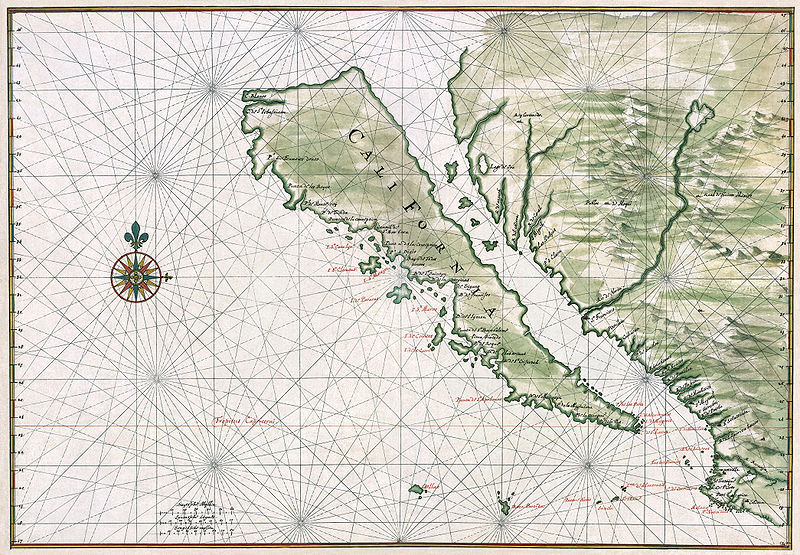
I just read a very interesting article about a non-existent island.  Non-existent islands have been a part of geography and history for quite some time.  Plato first wrote about Atlantis over two thousand years ago and people have been searching for it ever since it supposedly fell below the waves (of the Mediterranean or the Atlantic).  I have heard many theories about Atlantis over the years (ranging from sci-fi to alternate history to more realistic) including that some think the legend refers to a massive volcanic explosion in the Mediterranean.  However, the story of today was completely different.  It was akin to old stories of California Island (see image at left) that Europeans told for many years until they actually sailed to California and verified that there was only a peninsula--today's Baja California--and no island.

The BBC reports that "Sandy Island" which has been on maps for over a decade does not actually exist.
Google Maps screenshot, centered on Coral Sea

But when scientists from the University of Sydney went to the area, they found only the blue ocean of the Coral Sea.
The phantom island has featured in publications for at least a decade.
Scientist Maria Seton, who was on the ship, said that the team was expecting land, not 1,400m (4,620ft) of deep ocean.
--from BBC.co.uk, South Pacific Sandy Island 'proven not to exist'

Google Maps screenshot, "Sandy Island" between New Caledonia and Australia
I enjoy geography, maps, and atlases, so I found this story very interesting.  I'm sure it will just be an interesting story for many, but this makes me want to go search and see if the island featured in other maps.  The article explains that if it existed it would be within French territorial waters--but the island isn't on French government maps.  The closing paragraph of the article definitely made me grin.
The BBC's Duncan Kennedy in Sydney says that while most explorers dream of discovering uncharted territory, the Australian team appears to have done the opposite - and cartographers everywhere are now rushing to undiscover Sandy Island for ever.
--from BBC.co.uk, South Pacific Sandy Island 'proven not to exist'
I'm thankful that I have a good enough understanding of geography to know where in the world Sandy is (or isn't) once I read the article.  I'm grateful for the books that my parents purchased for me (including my first atlases) which allowed me to learn about such things.  I cringe every time I read articles about the appalling lack of geographic knowledge amongst modern students.  Also as I think ahead to our first child being born I want to make sure that he (or she) and his (or her) siblings properly appreciate history and geography.

~Matt

UPDATE: PS Sandy Island also appears on Apple Maps (which definitely doesn't use the same database that Google Maps utilizes).  I took this screenshot from Amy's iPad.

PPS [UPDATE 11.20.2012] I just read another fascinating blog on the subject of Sandy Island and discovered that the island appears on an old map also:
A librarian in Auckland, New Zealand located it on a chart of the Pacific Ocean, published in 1908 but first compiled in 1876. The island was sighted in that year by the British vessel Velocity.
--from Strange Maps, No Land Ho: Sandy Island and the Age of Un-Discovery

Wednesday, October 24, 2012

Butterflies in Flight

I just had the opportunity to watch the IMAX film Flight of the Butterflies.  It was a staff preview and it may be shown in the future at the Museum Center.  It was a most interesting film.  I enjoyed how it incorporated elements of the monarch migration that are known today with the story of the discovery of that route by Fred Urquhart.

It’s a natural history epic. It’s a compelling detective story. It’s a scientific adventure at its best. It took Dr. Fred Urquhart almost 40 years to discover the monarch butterflies’ secret hideaway and prove the most incredible migration on Earth. Following the year-long annual migration cycle of the butterflies, the award-winning production team filmed hundreds of millions of monarchs in their remote overwintering sanctuaries in Mexico in 2011 and again in 2012 and also along their migratory routes from Canada, across the U.S. and into Mexico. The technology of IMAX® immerses you in the astounding migration experience as two generations of the butterflies migrate north and then a Super Generation miraculously finds its way from Canada to a few isolated mountaintops in Mexico – to a place it has never been!
--from Flight of the Butterflies website, What is Flight of the Butterflies in 3D?
Female Monarch butterfly
If you enjoy nature documentaries then you should definitely watch this movie when it is available in a theater near you.  It was also fascinating to see how long it took for the whole story to unravel for the Urquharts as they studied Monarch butterflies for decades.  You'll also enjoy quite a few neat visual shots, especially those of Monarch swarms in Mexico.  The advertisements for the film indicate it is to be released in 3D, but the Omnimax Theater at the Museum Center doesn't utilize this component as far as I know.  It was still good, though I thought I could detect several shots that were designed for 3D.

It also brought to mind an article that I read on the BBC recently and brought to mind the different technology that is available to today's researchers.  The article involves a butterfly, the Painted Lady, found in the British Isles that just like Monarchs in North America seemed to "disappear" each year.

The mystery of an annual disappearance of a UK butterfly has been solved, scientists say after tracking the painted lady's migration on radar. 
They found that the butterflies do not die in this country at the end of summer, as some believed, but make a high altitude escape south - one leg of a 9,000-mile migration. 
The team analysed 60,000 sightings from British observers for the study. 
The discoveries are "astonishing", says Richard Fox, a co-author on the paper. 
The findings are based on data from 2009 and published in the journal Ecography.
--from BBC website, Radar helps solve painted lady migration mystery

The researchers involved in the project discovered that the butterflies were migrating southward, but at much higher elevations than had been previously suspected.  They were out of sight of ground-based observers as they flew at elevations up to a kilometer high (though they adjust altitude to find favorable winds).


The project combined the citizen science of "thousands and thousands" of eyes on the ground, from the "fringes of the Arctic circle" to sub-Saharan Africa, with high altitude insect-monitoring radar. It was these two working together that enabled the team to make the breakthrough, said Mr Fox. 
The radar element of the study was led in the UK by Rothamsted Research. It showed that the butterflies flew at an average height of over 500 metres on their way south, reaching speeds of up to 30 miles per hour (48km/h) in favourable winds.
It found that it could take up to six successive generations for the species to complete a 9,000-mile (14,400km) round trip from tropical Africa to the Arctic Circle. 
The journey is much longer than that undertaken by the famous Monarch butterfly, which migrates between Mexico and Canada.
--from BBC website, Radar helps solve painted lady migration mystery
I thought that the timing of the two stories was  interesting.  And now that I think about it I do remember raising some Monarch butterflies when I was a child in California.

Thursday, March 31, 2011

Strange Headline

Out of context this headline sounds very, very strange...

From the BBC: "Liverpool told to buy Asian stars"

~Matt

Wednesday, December 13, 2006

BBC on Creation

I'm actually quite impressed with a recent BBC article about the Creation Museum (being built just a few miles from me). The start the article has the usual caveat from secular sources, but they're not even that bad:
A new hi-tech temple to fundamentalist Christianity is due to open in the heart of Middle America next May, aiming to provide the grandest riposte yet to Darwinian evolutionary theory.

Staff and supporters of the Answers in Genesis organisation call it the Creation Museum.

But secular scientists would take issue with the use of either word to describe the almost completed building...

And here is how it ends:

Despite adopting the structure and technology of the most extravagant science museum, it remains that none of it is remotely plausible without first accepting Genesis.

Without taking that leap and rejecting centuries of scientific reasoning, it all resembles just another Disney-style magic kingdom.
Really it is an interesting read. Yes, there is that last sentence that seems to say that religion is anti-science--but the author recognizes that many of AIG's employees are highly qualified scientists--they aren't just "religious nuts."

It is refreshing to see someone actually take someone at face value. Instead of reinterpreting someone or something within your world view, sometimes you should examine them in light of their view. I look at someone differently if looking from a Christian perspective ("The fool says in his heart there is no God.") where I know others to be wrong or say from a political/American perspective where someone has the right to their own view.

Ah, that was confusing. All I'm trying to say is that you shouldn't try to fit people into the mold of your own world view. Lincoln was quite progressive for his time, but today would perhaps be a racist. The two worlds are so different though, that you shouldn't call the 16th president a racist. In the same way it would be nice if secularists showed respect for Creationists. No, they won't believe us, but they could at least not mock us--much like the attitude here:
[Ken Ham's] attitude towards committed atheist scientists is surprisingly respectful:

"Everyone starts from presuppositions. For example, Richard Dawkins says there is no God: that's his starting point.

"He'll admit that he has an a priori assumption of materialism, and we're saying we have an a priori assumption of the Bible."

I'm quite looking forward to the opening of the museum. It will be refreshing to go through a museum of Natural History and see the truth, not having to think "that's garbage" every few steps as Evolution is shoved down your throat as fact.

~Matt