On the day after we first saw the Lincoln Home site we drove south from our hotel to St. Louis so that we could explore Gateway Arch National Park. I had been to the site as a kid at least once and in 2012 on our big trip out west Amy and I had stopped by what was then the Jefferson Expansion National Memorial. First established in 1935 the park became a National Park in 2018.
The Gateway Arch reflects St. Louis' role in the Westward Expansion of the United States during the nineteenth century. The park is a memorial to Thomas Jefferson's role in opening the West, to the pioneers who helped shape its history, and to Dred Scott who sued for his freedom in the Old Courthouse.
--from Gateway Arch National Park
We found a parking garage downtown that wasn't too expensive and started walking towards the Arch. As it dominates the local skyline we didn't have any fears of getting lost.
The entrance to the museum is through a new west entrance that takes you underground.
Once there we bought our tickets for our trip up the Arch later and headed towards the Museum. On our way we saw this map showing the mater watercourses of North America.
As you approach the entrance to the museum we saw a number of screens setting the stage.
As you can see here there were also a number of narrower ones people walked past.
The museum looks quite a bit different than the last time we stopped in 2012 and is now quite a bit more open with many excellent exhibits.
You'll find many traditional signs and artwork just like you would in other museums.
However, the designers also really embraced technology and have incorporated a large number of screens with fascinating digital content.
This model shows a creole house of the type that many in St. Louis inhabited when it was a French settlement. Rather than being built on a foundation the house was built on logs placed "directly into the earth, with infill between the logs bousillage, which was made of mud, horsehair, and rocks. A Normal truss supports the roof, with a double pitch cascading over the galleries (porches) surrounding the house." --from exhibit signage
The first era presented in the museum was colonial St. Louis, from 1764 when the settlement was founded through 1804 when it was sold along with the rest of the Louisiana Purchase to the United States.
The city was founded as a trading post on the frontier, catering to the fur trade and commerce. The French had just lost their Canadian territories to Great Britain.
Not only were there visual exhibits, but the various galleries also had auditory components.
Have you ever felt a deer hide?
Again there were technological components such as this recipe demonstration.
After the colonial era other major incidents in American history became the focus of the Museum, such as the Mexican War.
Did you know the war was not universally popular in the US?
New Spain was a large territory that won its independence from Spain in 1821 after a long war.
American settlers in the area that is now Texas eventually revolted against the Mexican government, partly because they wanted to keep slaves even though Mexico had outlawed slavery. The self-proclaimed Republic of Texas claimed an area far larger than what it actually controlled. The war started after the US annexed Texas and sent troops into the disputed lands between the Rio Grande and Nueces rivers where they got into a skirmish with Mexican forces.
Ulysses S. Grant was one of those who had been opposed to the war.
During the war American forces even occupied Mexico City.
The treaty of Guadalupe Hidalgo ended the war and ceded all of northern Mexico to the United States.
In the years after the Mexican War many different groups headed west, especially into the Oregon Territory jointly administered by Great Britain and the United States.
The Mormons also headed west where they founded the colony that became Utah.
And in 1849 the lure of gold drew hundreds of thousands of people to California.
While the Pony Express gets the fame stagecoaches were a more popular method of traveling through the west for people and mail before the railroads.
From 1840 to 1860 the nation was consumed by the concept of Manifest Destiny and expansion. I appreciated that the museum presented three different viewpoints on this era, from the American population of the time to Hispanic and Native American groups. You cannot study this era and fine simple answers--it is full of nuance and different perspectives.
James Polk was a president consumed with expanding the United States.
The Mexican War was called the Yankee Invasion in Mexico and caused a massive disruption to the status quo--much more than earlier purchases of lands or more peaceful transitions had.
Also don't forget about the hundreds of treaties that have been made with Native American tribes, not all of which have been honored, or perhaps "honored more in the breach than in the observance" to quote the Bard.
This presentation I thought effectively presented the geographic context of an undoubtedly complex issue concerning American Indian Lands.
In 1783 European colonization of the then and future United States hadn't expanded much beyond the eastern seaboard.
By 1875 there had been many, many different broken treaties and the situation was much different.
I enjoyed seeing some artwork by Charles M. Russell.
There was also an opportunity to touch a bison hide.
Did you know that several ironclads were built south of St. Louis? Sister ships including the Cincinnati were built in Mound City, Illinois.
The museum contained many, many more exhibits, more than I can possibly cover here. If you're in the area it is well worth checking out. It will definitely help you to think through what the era of westward expansion looked like.
~Matt
Showing posts with label Missouri. Show all posts
Wednesday, June 03, 2020
Gateway Arch National Park - Museum
Tags:
History,
Missouri,
National Parks
Location:
St. Louis, MO 63102, USA
Thursday, July 12, 2012
National Expansion
On the first day of our big summer trip (yes, I'm blogging about it at long last) we drove to Kansas. We actually got to be in quite a few states that day. We started in Kentucky, drove through Ohio for a bit (thanks I-275), Indiana, Illinois, Missouri, and then Kansas. While in St. Louis we decided to stop at the Jefferson Expansion National Memorial down by the river. Like many things this trip the Arch was something I hadn't seen in many years, since I was a kid. The trip was one of rediscovery for me and of showing things I knew to Amy. :-)
Besides stopping to see the arch (and the museum underneath it) I wanted to buy an annual parks pass. I'd been looking ahead and knew that we would need to pay $25 to enter Yellowstone. I also noticed that there would be plenty of NPS sites along our route, and while some were free a fair number did have entrance fees. Therefore I figured it would be worth it to spend $80 and get an America the Beautiful Annual Pass. The pass covers Amy and I (or the whole car we're in if fees are charged by the carload):
Once we'd parked at the arch we walked through a beautiful grove of trees towards the base of the arch and the museum and visitor center buried beneath it. I'd looked ahead and knew that security was tight:
Once inside we looked around for a bit and I ended up getting my pass. By the way, if you are over age 62 you need to buy the Senior Pass. It is only $10 and it is a lifetime pass that will get you into National Park Service and other "Federal recreation sites that charge an Entrance Fee or Standard Amenity Fee." Trust me, you want it, ;-). I know that my parents have one and they've used it.
There was a ticketing area, but we didn't visit it. The Museum is free, the tickets are just for the car up to the top of the arch. I want to go up again sometime, but this was not the trip for that.
I did really enjoy the first display that we saw telling the history of the arch via a bas relief panel. Sadly I only have one picture of the display. However, it did compare the height of many other memorials and structures--showing that the arch is quite tall.
The Museum of Westward Expansion is laid out in a slightly confusing manner--you really have to pay attention to realize where the timeline progresses. We didn't want to spend too much time looking around (as we still needed to drive beyond Kansas City) so I only took a few pictures at first. As I mentioned, much of the museum was laid out around the concept of a timeline of the nineteenth century, part of which you can experience on the NPS website.
As much as I like signs there were simply too many to take pictures of during the limited time that we had available, so the large displays caught my attention and that of my cameras.
I did see a sign a couple times that I thought was quite good (if it was read by guests). It mentions that only live animals can regrow hair--so if you touch a stuffed animal and cause its hair or fur to wear off it can't be replaced!
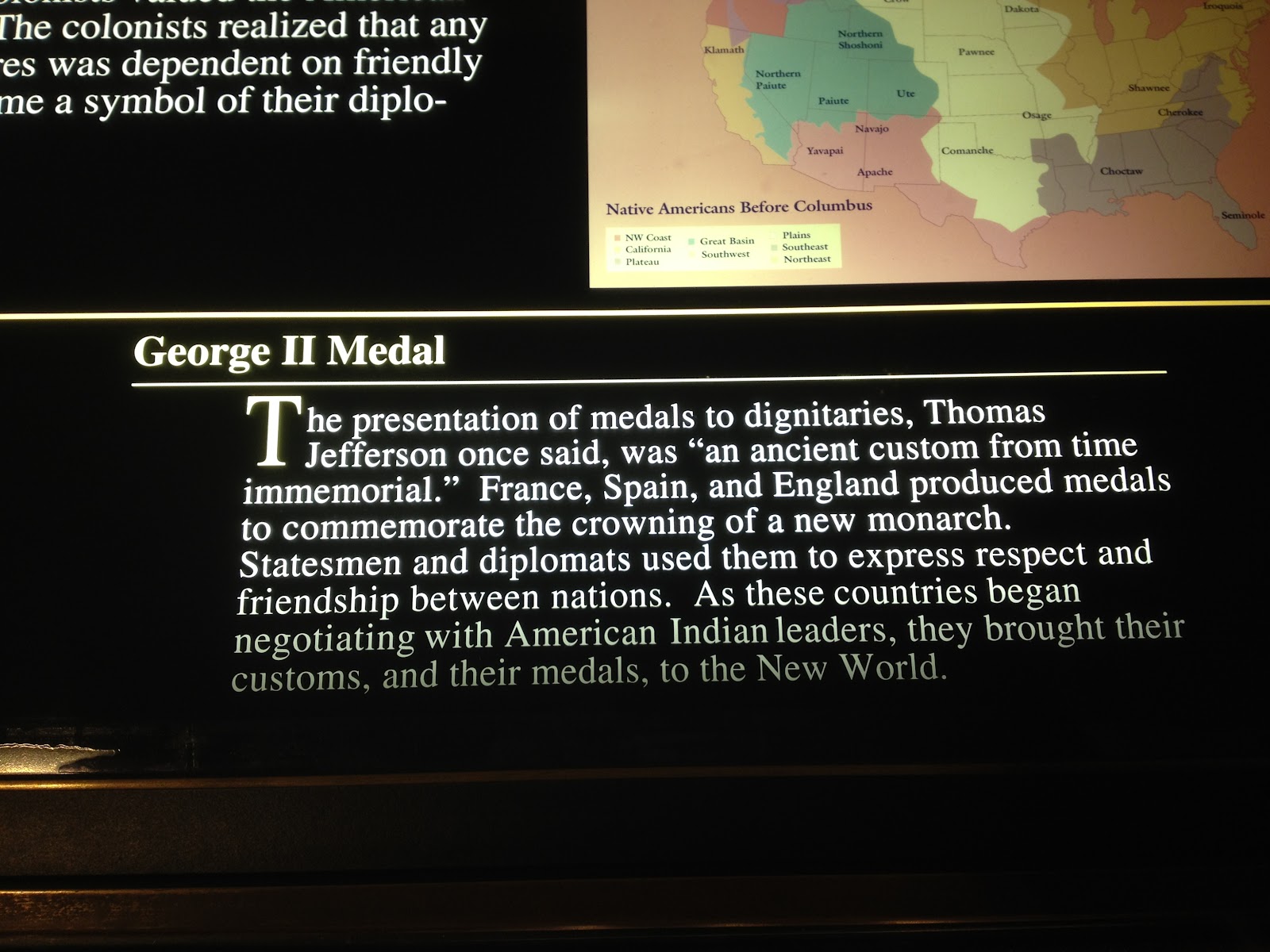
I found a large exhibit on Indian peace medals to be quite interesting. Apparently they were traded and then manufactured as tourist items fairly early on in the 1800s. There was even an animatronic of an engraver from the mint.
The British made the first medals to be used, which isn't surprising, especially in light of the tribes that later allied with the British during the American Revolution.
The Jefferson medal was apparently a model for future medals. It is one of the designs that recently appeared on the nickle redesign, and I got a smashed penny with the design also.
We also enjoyed spending some time in the shops. I of course had to buy a few postcards (including some duplicates for mailing to people). The themed shop was the most fun with products and displays that looked to be straight out of the 1800s.
Amy even found a book that she thought was pretty cool, though we didn't end up buying it. Okay, I should mention that Amy remembers the Oregon Trail computer games and is convinced that just about everyone died on the trail, ;-), so a book entitled "the tragic tale" about the Oregon Trail seemed to be quite appropriate to her.
So someday we'll definitely be back to the Gateway Arch. And next time we'll take the ride to the top and I'll take plenty of pictures from up there.
~Matt
Besides stopping to see the arch (and the museum underneath it) I wanted to buy an annual parks pass. I'd been looking ahead and knew that we would need to pay $25 to enter Yellowstone. I also noticed that there would be plenty of NPS sites along our route, and while some were free a fair number did have entrance fees. Therefore I figured it would be worth it to spend $80 and get an America the Beautiful Annual Pass. The pass covers Amy and I (or the whole car we're in if fees are charged by the carload):
This pass is available to the general public and provides access to, and use of, Federal recreation sites that charge an Entrance Fee or a Standard Amenity Fee. The card is good for one year, beginning with the date of sale. The cost is $80.00. The pass admits holders and passengers in a non-commercial vehicle at "per vehicle" fee areas. It also allows the pass holder, plus three adults (not to exceed four adults), at "per person" fee areas. Children under the age of 16 years are admitted free.It was a great deal and I'm determined to get our money's worth by visiting as many sites as we reasonably can. We bought the pass on June 1, so it is good for 13 months--expiring at the end of June, 2013. So if you're keeping up on my summer blog posts expect a fair number of them to be about National Park Service sites.
Once we'd parked at the arch we walked through a beautiful grove of trees towards the base of the arch and the museum and visitor center buried beneath it. I'd looked ahead and knew that security was tight:
Security Note:It was quicker than TSA checkpoints though, so that was something to be thankful for. I didn't think they'd appreciate a picture of the checkpoint however, so I refrained. The arch has been around a while and I had to get a picture of the dedication plaque on display right by the entrance.
Due to security measures at the Gateway Arch, all visitors to the Arch must pass through a security checkpoint. No weapons--including knives--are allowed. If you have pre-purchased your tram ticket, please arrive at least 30 minutes before your tram time.
Once inside we looked around for a bit and I ended up getting my pass. By the way, if you are over age 62 you need to buy the Senior Pass. It is only $10 and it is a lifetime pass that will get you into National Park Service and other "Federal recreation sites that charge an Entrance Fee or Standard Amenity Fee." Trust me, you want it, ;-). I know that my parents have one and they've used it.
There was a ticketing area, but we didn't visit it. The Museum is free, the tickets are just for the car up to the top of the arch. I want to go up again sometime, but this was not the trip for that.
I did really enjoy the first display that we saw telling the history of the arch via a bas relief panel. Sadly I only have one picture of the display. However, it did compare the height of many other memorials and structures--showing that the arch is quite tall.
The Museum of Westward Expansion is laid out in a slightly confusing manner--you really have to pay attention to realize where the timeline progresses. We didn't want to spend too much time looking around (as we still needed to drive beyond Kansas City) so I only took a few pictures at first. As I mentioned, much of the museum was laid out around the concept of a timeline of the nineteenth century, part of which you can experience on the NPS website.
1800:
The U.S. Capitol is moved from Philadelphia, and Congress convenes in Washington D.C. for the first time. By secret treaty, Spain cedes the Louisiana Territory to France. Second census: U.S. Population- 5,309,000.
1801:
Thomas Jefferson is inaugurated as the third President of the United States in the first Presidential inauguration to be held in Washington, D.C. Johnny Appleseed (real name John Chapman) arrives at Licking County, Ohio with a bag of apple seeds.
1802:
The "right of deposit" for Americans is withdrawn by the Spanish in New Orleans. American pioneers west of the Appalachians are greatly alarmed by this move, since New Orleans is the only port through which they can sell their products profitably. The move prompts President Jefferson to begin negotiations for the purchase of New Orleans, which culminate in the Louisiana Purchase.
1803:
France sells Louisiana to the United States for $15,000,000. This first territorial expansion of the U.S. west of the Mississippi totals 828,000 square miles. Army officers Meriwether Lewis and William Clark are chosen by President Jefferson to lead an expedition from St. Louis to the Pacific Ocean, for the purpose of discovering a direct water route across the continent and to keep records of the natural resources of the new land, with the aim of establishing an American presence in the northwest through trade and settlement.
As much as I like signs there were simply too many to take pictures of during the limited time that we had available, so the large displays caught my attention and that of my cameras.
I did see a sign a couple times that I thought was quite good (if it was read by guests). It mentions that only live animals can regrow hair--so if you touch a stuffed animal and cause its hair or fur to wear off it can't be replaced!
I found a large exhibit on Indian peace medals to be quite interesting. Apparently they were traded and then manufactured as tourist items fairly early on in the 1800s. There was even an animatronic of an engraver from the mint.
The British made the first medals to be used, which isn't surprising, especially in light of the tribes that later allied with the British during the American Revolution.
The Jefferson medal was apparently a model for future medals. It is one of the designs that recently appeared on the nickle redesign, and I got a smashed penny with the design also.
We also enjoyed spending some time in the shops. I of course had to buy a few postcards (including some duplicates for mailing to people). The themed shop was the most fun with products and displays that looked to be straight out of the 1800s.
Amy even found a book that she thought was pretty cool, though we didn't end up buying it. Okay, I should mention that Amy remembers the Oregon Trail computer games and is convinced that just about everyone died on the trail, ;-), so a book entitled "the tragic tale" about the Oregon Trail seemed to be quite appropriate to her.
So someday we'll definitely be back to the Gateway Arch. And next time we'll take the ride to the top and I'll take plenty of pictures from up there.
~Matt
Tags:
Amy,
History,
Missouri,
National Parks,
Vacation
Subscribe to:
Posts (Atom)