Friday, July 13, 2012

Denver Science

On the second day of our trip we had some time to kill at the end of the day.  We got into Denver a bit earlier than expected, so we decided to go to the Denver Museum of Nature and Science.  We got free admission to the museum because of my staff membership at the Cincinnati Museum Center, which has reciprocity through the Association of Science and Technology Centers.  We didn't have much time, but since admission was free I figured that the visit would be worth it.

We came through a storm on our way into Denver (I did really enjoy smelling the storm coming as we drove into it) but it wasn't raining (or not too hard) by the time we got to the Museum.  I thought that the outside ticket purchase was pretty interesting.  I wonder if it was for early mornings before the museum opens or for days with really long lines.


The entrance area was quite large.  It appeared to be part of an expansion onto the original building (or buildings) to expand the inside surface area.  I've seen the ticket sales areas at a good number of museums, and I thought they did a good job on the design in Denver.


The first area we explored was the Gems and Minerals permanent exhibit.

"Got your hard hat? In Coors Mineral Hall, follow the mine shaft into a Mexican silver mine, where a cavern glistens with milky white gypsum crystals and stalactites. Then enter Colorado's own Sweet Home Mine to discover a six-foot wall of blood-red rhodochrosite crystals."
"Colorado was founded on mining, and in the historical mining section you'll see more local finds, like Tom's Baby, an eight-pound nugget of crystallized gold unearthed in Breckenridge in 1887."

"You'll also uncover Brazilian topaz, California watermelon tourmaline, Australian opals, intense blue azurite, green malachite, four-inch zeolite needle sprays from India, and hundreds of other dazzling specimens from around the world. Hands-on activities and videos help young explorers learn about mineral characteristics and how minerals form."

There was far more than we could see in the short time that we had available, but we did see quite a few minerals.  The florescent display was neat.  I took pictures under both normal and  florescent light.


Part of the exhibit was even themed like a mine.

We also saw an aquamarine display.  The picture of the display isn't the clearest, but I think you can still read some of it.

After the minerals exhibit we headed into a space area that was amazing!  I've enjoyed sci-fi for quite a few years, and ever since I've started working Stargazer's Nights I've been enjoying studying regular astronomy as well.  I thought we might just look around this area for a minute or two (I was anxious to see the animal displays upstairs), but I could have easily spent quite a bit of time in the area.

As you emerge from an entry corridor with views of space, a dramatic Martian canyon lies to your right. To your left, dust and gas swirl in giant nebulae. This is Space Odyssey, where the universe is yours to explore-and where space news headlines are brought to life.

Above you can see part of the Mars exhibit.  It shows what a future exploration base on the red planet might look like.  I'm a sucker for models and exhibits like this one.  I remember a space exhibit that I worked on at the Museum Center which included an area like this one (but not as nice).  The oceanic earth glob was also pretty neat, even though it was an old exhibit.
One of my favourite sights through a telescope is the planet Saturn (the other is the Orion Nebula--which looks much better through the scope than any pictures that I've seen).  I love seeing the rings, and I like listening to the reaction of people actually seeing the planet for the first time.  Some people have even thought that it was something fake taped onto the end of the telescope.  So it was with great happiness that I found the following exhibit.
But even better than the display demonstrating the changes in views of Saturn was the explanation of reflecting and refracting telescopes.  People often ask me what the difference is and I can't always remember a good way to describe them, so having a display like this next one would be quite useful.
But next I saw something even better!  During the live program we've developed for Stargazer's Nights we talk about the brightness of stars.  Some stars are brighter, but further away than others, so they appear dimmer.  A great example can be found in the Big Dipper.  The text is somewhat hard to read so I'll type it below: "The lights above represent the stars of the Big Dipper in their true position in space. Do they form the familiar Big Dipper pattern from your present position? Where must you be to see the stars in the shape of the Big Dipper?" There were several of these signs spread throughout the area.  When you look at the stars from a different direction they don't form the same shape because the stars are not all the same distance from the earth.  The constellations are defined by their view from earth and are usually unrecognizable from other locations in space.  Look for the circular white lights in the picture below.  They're mostly, but not completely in the right shape.  I don't remember what location I took this from.
I thought I took a video, but I can't find the file, :(.  Hopefully you can understand the concept from my meager description.
The animal dioramas reminded me of the exhibits at Chicago's Field Museum.  I know they're not the most popular things to have in new museums, but I really enjoy them.  A well done taxidermy exhibit looks much better than something created from scratch, in my opinion, and some of these animals are endangered or extinct, so you won't get any more specimens to create new displays.  There were several different areas including North America, Africa, Australia, and more.
I was quite impressed by the glass used in the displays.  It was very nice glass and kept well clean.  I couldn't see it unless I was looking very carefully or the flash was bouncing off it.
Can you find the squirrel in the scene below?  Several of the scenes had quite a few animals hidden (as they would naturally go through the forest) within them.

I also enjoy seeing animals that I may never (or rarely) get to see in the wild.
It was also quite interesting to note that an event was being setup.  I've seen this at many museums I've visited (as well as both that employ me).  But this would be an especially nice area to eat dinner, surrounded by the animal dioramas.
I knew the albatross was a large bird, but I'd forgotten how huge they actually were.

We also found a fun display on the floor that illustrated the difference between a cheetah and impala running. I've never been to Africa, and I haven't been to a zoo in a while (and the San Diego Wild Animal park never--though I want to visit someday), so I really liked seeing those animals. Though the displays were static, I took a couple videos so that I could pan across the scenes.  Sadly as I tried to focus in on a couple of things the camera refused to focus, but I think the scene is still nicely visible.

The contrast in the Australian scenes was also interesting.  I'm currently reading The Fatal Shore, a book about Australia's early founding, especially the history of convict settlement of the continent.  The initial conditions at Sydney and the first Tasmanian colonies were not easy.  There is a variety of terrain in the antipodean continent, from lush areas to dry scrub.
Who doesn't like the koala?
Australia also has some pretty amazing animals that aren't found anywhere else.


 We briefly explored the Egyptian section which included a mummy and some really neat models.


We could have spent plenty of more time in the museum and I'd definitely like to go back the next time we're in Colorado and have some free time.
~Matt

Thursday, July 12, 2012

National Expansion

On the first day of our big summer trip (yes, I'm blogging about it at long last) we drove to Kansas.  We actually got to be in quite a few states that day.  We started in Kentucky, drove through Ohio for a bit (thanks I-275), Indiana, Illinois, Missouri, and then Kansas.  While in St. Louis we decided to stop at the Jefferson Expansion National Memorial down by the river.  Like many things this trip the Arch was something I hadn't seen in many years, since I was a kid.  The trip was one of rediscovery for me and of showing things I knew to Amy.  :-)

Besides stopping to see the arch (and the museum underneath it) I wanted to buy an annual parks pass.  I'd been looking ahead and knew that we would need to pay $25 to enter Yellowstone.  I also noticed that there would be plenty of NPS sites along our route, and while some were free a fair number did have entrance fees.  Therefore I figured it would be worth it to spend $80 and get an America the Beautiful Annual Pass.  The pass covers Amy and I (or the whole car we're in if fees are charged by the carload):
This pass is available to the general public and provides access to, and use of, Federal recreation sites that charge an Entrance Fee or a Standard Amenity Fee. The card is good for one year, beginning with the date of sale. The cost is $80.00. The pass admits holders and passengers in a non-commercial vehicle at "per vehicle" fee areas. It also allows the pass holder, plus three adults (not to exceed four adults), at "per person" fee areas. Children under the age of 16 years are admitted free.
It was a great deal and I'm determined to get our money's worth by visiting as many sites as we reasonably can.  We bought the pass on June 1, so it is good for 13 months--expiring at the end of June, 2013.  So if you're keeping up on my summer blog posts expect a fair number of them to be about National Park Service sites.


Once we'd parked at the arch we walked through a beautiful grove of trees towards the base of the arch and the museum and visitor center buried beneath it. I'd looked ahead and knew that security was tight:
Security Note:
Due to security measures at the Gateway Arch, all visitors to the Arch must pass through a security checkpoint. No weapons--including knives--are allowed. If you have pre-purchased your tram ticket, please arrive at least 30 minutes before your tram time.
It was quicker than TSA checkpoints though, so that was something to be thankful for.  I didn't think they'd appreciate a picture of the checkpoint however, so I refrained.  The arch has been around a while and I had to get a picture of the dedication plaque on display right by the entrance.


Once inside we looked around for a bit and I ended up getting my pass.  By the way, if you are over age 62 you need to buy the Senior Pass.  It is only $10 and it is a lifetime pass that will get you into National Park Service and other "Federal recreation sites that charge an Entrance Fee or Standard Amenity Fee."  Trust me, you want it, ;-).  I know that my parents have one and they've used it.


There was a ticketing area, but we didn't visit it.  The Museum is free, the tickets are just for the car up to the top of the arch. I want to go up again sometime, but this was not the trip for that.


I did really enjoy the first display that we saw telling the history of the arch via a bas relief panel.  Sadly I only have one picture of the display.  However, it did compare the height of many other memorials and structures--showing that the arch is quite tall.


The Museum of Westward Expansion is laid out in a slightly confusing manner--you really have to pay attention to realize where the timeline progresses.  We didn't want to spend too much time looking around (as we still needed to drive beyond Kansas City) so I only took a few pictures at first.  As I mentioned, much of the museum was laid out around the concept of a timeline of the nineteenth century, part of which you can experience on the NPS website.

1800:
The U.S. Capitol is moved from Philadelphia, and Congress convenes in Washington D.C. for the first time. By secret treaty, Spain cedes the Louisiana Territory to France. Second census: U.S. Population- 5,309,000.
1801:
Thomas Jefferson is inaugurated as the third President of the United States in the first Presidential inauguration to be held in Washington, D.C. Johnny Appleseed (real name John Chapman) arrives at Licking County, Ohio with a bag of apple seeds. 
1802:
The "right of deposit" for Americans is withdrawn by the Spanish in New Orleans. American pioneers west of the Appalachians are greatly alarmed by this move, since New Orleans is the only port through which they can sell their products profitably. The move prompts President Jefferson to begin negotiations for the purchase of New Orleans, which culminate in the Louisiana Purchase. 
1803:
France sells Louisiana to the United States for $15,000,000. This first territorial expansion of the U.S. west of the Mississippi totals 828,000 square miles. Army officers Meriwether Lewis and William Clark are chosen by President Jefferson to lead an expedition from St. Louis to the Pacific Ocean, for the purpose of discovering a direct water route across the continent and to keep records of the natural resources of the new land, with the aim of establishing an American presence in the northwest through trade and settlement. 


As much as I like signs there were simply too many to take pictures of during the limited time that we had available, so the large displays caught my attention and that of my cameras.

I did see a sign a couple times that I thought was quite good (if it was read by guests).  It mentions that only live animals can regrow hair--so if you touch a stuffed animal and cause its hair or fur to wear off it can't be replaced!

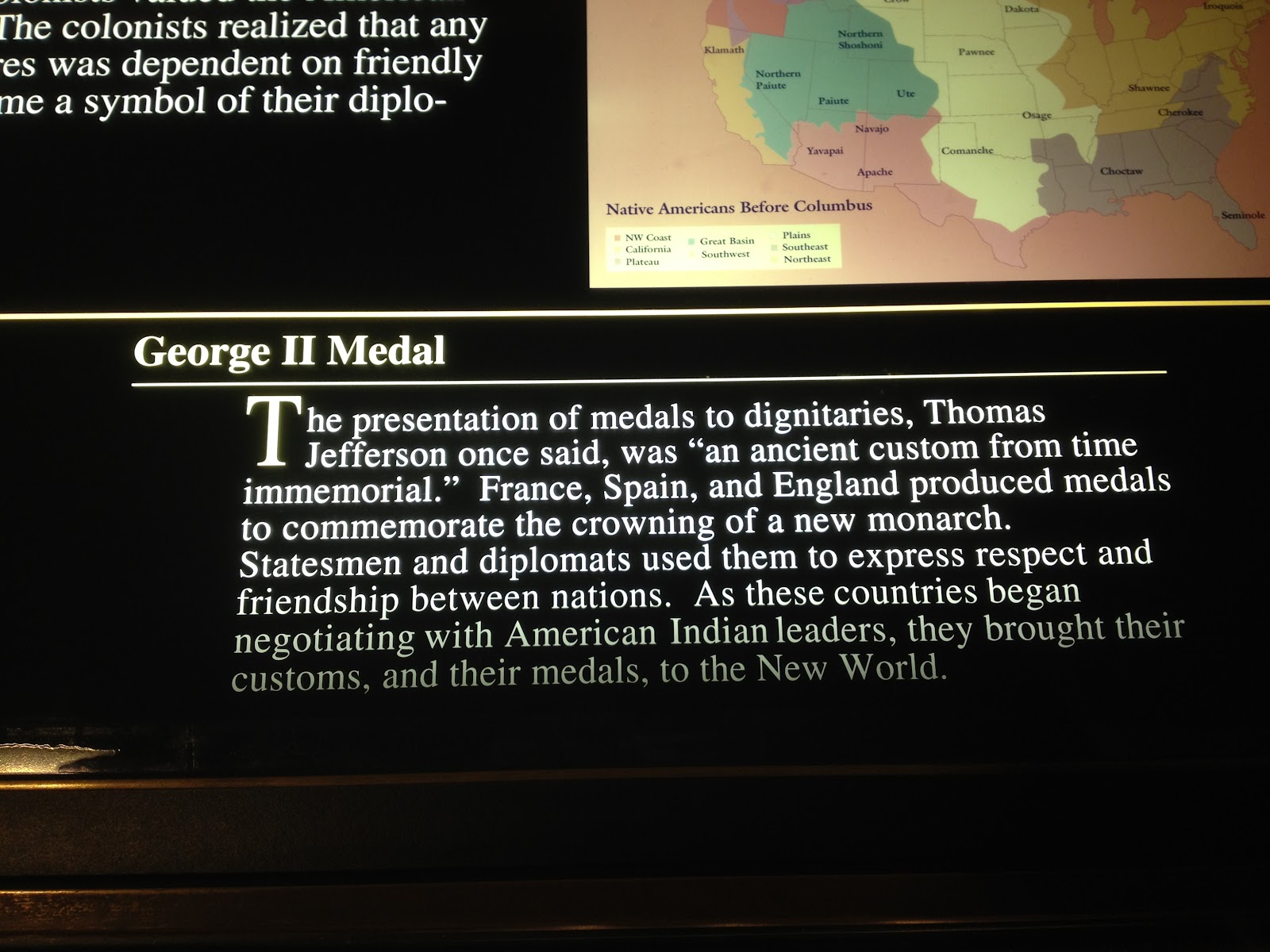
I found a large exhibit on Indian peace medals to be quite interesting.  Apparently they were traded and then manufactured as tourist items fairly early on in the 1800s.  There was even an animatronic of an engraver from the mint.

The British made the first medals to be used, which isn't surprising, especially in light of the tribes that later allied with the British during the American Revolution.


The Jefferson medal was apparently a model for future medals.  It is one of the designs that recently appeared on the nickle redesign, and I got a smashed penny with the design also.


We also enjoyed spending some time in the shops.  I of course had to buy a few postcards (including some duplicates for mailing to people).  The themed shop was the most fun with products and displays that looked to be straight out of the 1800s.

Amy even found a book that she thought was pretty cool, though we didn't end up buying it.  Okay, I should mention that Amy remembers the Oregon Trail computer games and is convinced that just about everyone died on the trail, ;-), so a book entitled "the tragic tale" about the Oregon Trail seemed to be quite appropriate to her.

So someday we'll definitely be back to the Gateway Arch.  And next time we'll take the ride to the top and I'll take plenty of pictures from up there.

~Matt

Monday, June 04, 2012

Passport to Adventure


I've had several National Parks passport books over the years. I still have my first one, but unfortunately I didn't have it with my one time at a park and I ended up buying another one. That one was only used once and was then left at home (I don't have a stamp from the Statue of Liberty and Ellis Island though I did visit them). My third (and hopefully final) book is kept in my car do it is handy.

Whenever I visit a unit of the National Park Service I look for the cancellation station and stamp my passport book. I really enjoy it and it is a great way to track visits. I hope to do this when we have kids someday also.

Recently I discovered a Passport app developed by Eastern National and I downloaded it immediately. It has a couple purposes. I input all of my visits from all three books (thus the above number indicating I've been to 32 parks). It is also helpful in finding where cancellation stations are located in each park.

Lastly I've looked up the parks that are along the remainder of our route and I've marked them as parks to visit. Hopefully we'll be able to visit all nine! Then someday I'll go back to New York City and properly record my visit.

If you visit National Parks frequently or even semi-frequently then check out the passport program. It is quite a bit of fun. I've thoroughly enjoyed it since I was a kid.

~Matt

-- Posted from my iPhone
(c) 2012 iWolff Ltd.

Location:W 3600 S,Perry,United States